

Student Hackathon
2026 Chemeca Student Hackathon
The hackathon will comprise of two rounds. In the first round, there will be an introductory session in which the specific hackathon problem is revealed, followed by briefings by industry experts, and a Q&A session that will assist in developing your entry.
During the following weeks, each team will work on their proposal and at the conclusion in early August, teams will be asked to submit a short, visually appealing document of no more than two A4 pages (or one A3 page) and a short three to five minute video presentation outlining their proposed solution.
Finalists from the first round will be invited to deliver an in-person pitch at Chemeca 2026 in Melbourne, Victoria.
-
Create a conceptual design that provides an alternative to conventional iron ore reduction and steel production, with a focus on significantly lowering carbon intensity during processing and/or improving the efficiency of energy and fuel infrastructure to enable large-scale decarbonisation of iron and steel production in Australia or New Zealand
Download the full case competition document here.
-
4–6 Members
You are welcome to include up to 2 team members from disciplines other than chemical engineering
At least 4 team members must be able to attend Chemeca in Melbourne, Victoria
Open to undergraduate, masters or PhD students (maximum 2 PhD students per team) studying Chemical Engineering
Most universities have a nominated coordinator – they may be able to assist if you are having difficulty finding enough people to form a team
Each team member needs to register for the conference individually. Details will be sent to finalist teams on how to register.
-
1st Prize – Mentoring with Hackathon sponsors and AUD $500 cash prize per team member
2nd Prize – Mentoring with Hackathon sponsors and AUD $350 cash prize per team member
3rd Prize – AUD $200 cash prize per team member
-
Hackathon information session: Tuesday 31 March 16:00 - 17:00 AEDT.
Team registrations: CLOSED
Hackathon information session: The Art of the Pitch, Wednesday 1 July 16:00 - 17:00 AEST.
First rounds entries due: Friday 31 July 2026, 12:00PM AEST/ 2:00PM NZST
Finalists notified by: Wednesday 12 August 2026
Chemeca conference: 28 - 30 September 2026
Hackathon twist begins: Monday 28 September 2026
Final pitch presentations and winner decided: Wednesday 30 September 2026
-
Can we have multiple students from other engineering disciplines (like mechanical, petroleum, mining) in our team?
Unfortunately, we can only accept a maximum of 2 team members from another discipline. The rest of the team members must be studying chemical engineering.
Can I participate if I'm graduating this year?
Yes! The competition is open to undergraduate, masters or PhD students (maximum 2 PhD students per team)
Can students from outside of Australia or New Zealand compete in the Hackathon?
Unfortunately the competition is only open to students from Australian or New Zealand universities.
Does the team need to be in the same university?
Not necessarily - you can ‘team up’ with members from other universities in your state/territory.
Is it possible to take part in the competition without being in a group?
Due to the nature of the competition and the amount of work involved, only teams of 4-6 members will be considered for entry.
-
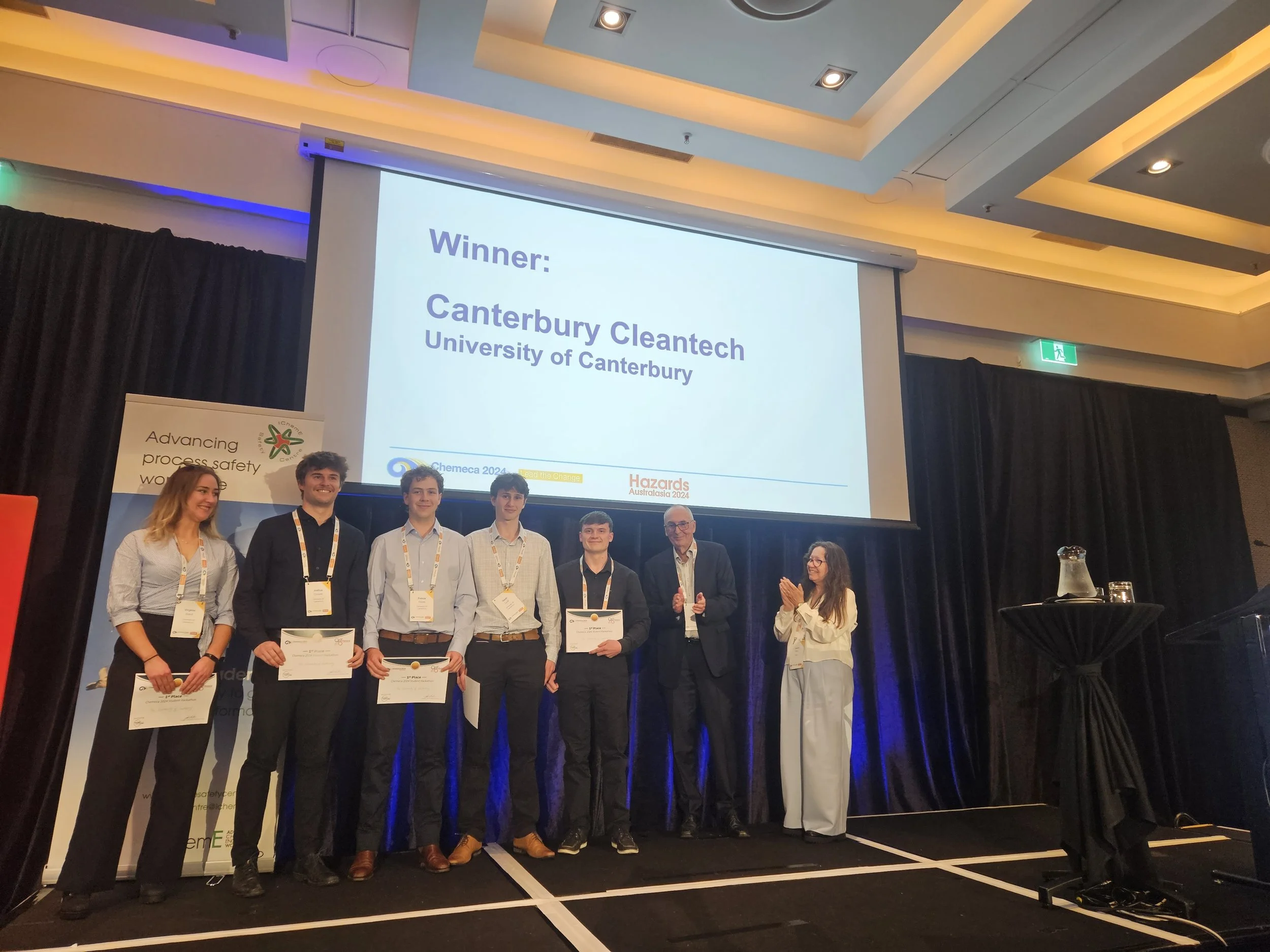
If you’re looking for inspiration for your poster submission as part of the first round entry for the Hackathon competition, our past finalist teams have provided their posters to share with future Hackathon participants:
View the 2024 Hackathon Finalist Posters
View the 2025 Hackathon Finalist Posters
Please note; not all finalist teams have given permission to have their poster published. Posters are for reference only and are not to be plagiarised or shared.
Thank you to our 2026 Chemeca Student Hackathon Sponsors
Chemeca sessions
During Chemeca 2026, there will be further elements to the problem revealed that will need to be incorporated into the final pitch.
To assist with delivering the best possible pitch, there will be a number of relevant Chemeca sessions to attend, together with the opportunity to speak to keynote speakers and conference participants during breaks.
The hackathon will conclude with each group giving a short presentation and answering questions from a judging panel of industry experts.
2026 Student Hackathon Information Session - Tuesday 31 March 2026
We recently held our first information session for our 2026 Student Hackathon competition.
Hosted by our co-sponsors, HILT CRC and CSIRO, our 2026 Hackathon committee chair Alireza Salmachi took attendees through this year’s problem statement, the competition details including team composition and what is required for the first-round entries.
During the webinar, our co-sponsor and committee member, Keith Vining from CSIRO gave attendees a technical overview of current and emerging steelmaking processes, discussing the challenges of decarbonisation, the role of blast furnaces, electric arc furnaces, and potential future technologies, and highlighted the importance of considering resource availability and process modifications.
A reminder that team registrations are now open and students are encouraged to form their teams and register for the competition by the 29th May 2026.
For any questions, please see the FAQs on this page or contact chemeca@icheme.org
2026 Student Hackathon ‘Art of the Pitch’ Webinar - Wednesday 1 July 2026
On Wednesday 1 July, we delivered our second and final Hackathon information session, The Art of the Pitch — a dynamic and practical webinar designed to help students sharpen their communication and storytelling skills ahead of this year’s competition.
The session was hosted by Andrea Hosey, Hackathon Committee member and long‑standing judge, who opened by walking participants through the problem statement and the essential elements required in a strong team submission.
Andrea then welcomed our expert panelists:
Nicola Barry, Technical and Delivery Services Director, Worley NZ
Rhys Tucker, CTO, Abel Energy
Lauren Williamson, Research Group Leader – Carbon Steel, CSIRO
Together, they shared real-world insights into pitching innovative solutions to potential clients — covering what makes a compelling pitch, common pitfalls to avoid, and the strategies that have helped them succeed in high‑stakes environments.
Students engaged throughout the discussion, asking questions and receiving practical, experience-based advice from the panel. The session offered valuable guidance for teams preparing to present their ideas for their Stage 1 submissions.
For any questions, please see the FAQs on this page or contact chemeca@icheme.org
2025 Hackathon highlights
Want to see what’s in store for finalists? Check out this video to see what our 2025 Hackathon Finalists teams got to enjoy at the Chemeca conference.
Highlights include:
The conference opening and welcome reception where all finalist teams got to meet and receive the problem statement “twist”
An exciting behind the scenes tour at Adelaide’s iconic Haigh’s Chocolate Factory - chocolate tasting included!
Final pitch presentations and the winner crowned.
Stay tuned for updates for this year’s Chemeca Student Hackathon competition. If you have any questions, please contact chemeca@icheme.org